For brands that refuse to compromise on quality. We solve the cat litter industry's hardest engineering problems — tray adhesion, shipping segregation, long-term odor control, and climate adaptation — with measurable, guaranteed results.
These are the performance failures that generate the most consumer complaints, the most retailer returns, and the most brand damage — and that most manufacturers simply cannot solve.
When a clump forms before it fully hardens, the wet base layer bonds to the tray surface. Consumers spend minutes scraping — and then they leave a one-star review.
Mixed litters with components of different densities separate during 30–45 days of sea freight vibration. Retailers receive bags where heavy granules have sunk and light pellets floated — and customers notice.
Single-mechanism litters — especially plant-based types — exhaust their odor control capacity quickly in multi-cat or small apartment environments. Consumers perceive this as a product failure.
A formula that performs perfectly in a 20°C / 50% RH test environment can fail within days in Singapore (32°C / 85% RH), causing premature clumping, mold growth, or pellet softening.
A competitor has a product that out-performs yours in clumping, odor, or texture — and you don't know why. Your current supplier says it can't be improved. The gap costs you market share every month.
Plant-based binders can lose clumping performance below 5°C — a real problem for unheated warehouses and outdoor pet areas in Northern Europe, Canada, and Japan in winter.
We don't just say we can fix it. We explain exactly how — so your technical team can evaluate and verify our approach before committing.
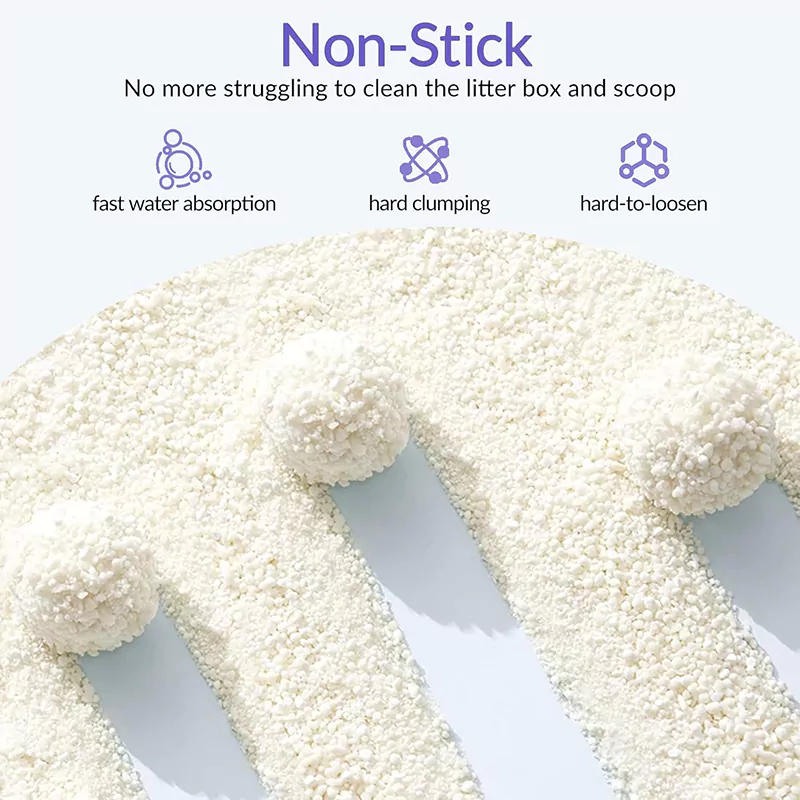
Tray adhesion is caused by the base layer of a forming clump remaining liquid while the top layer hardens. The wet base layer chemically bonds to the tray surface before the clump has enough structural integrity to release cleanly.
We solve this through two parallel approaches depending on the base material:

Particle segregation in mixed litters is driven by density differential and vibration frequency. In a 40HQ container crossing the Pacific, a blend of 0.55 kg/L tofu and 0.95 kg/L bentonite will naturally separate — the heavier granules migrate downward over thousands of miles of road and ocean vibration.
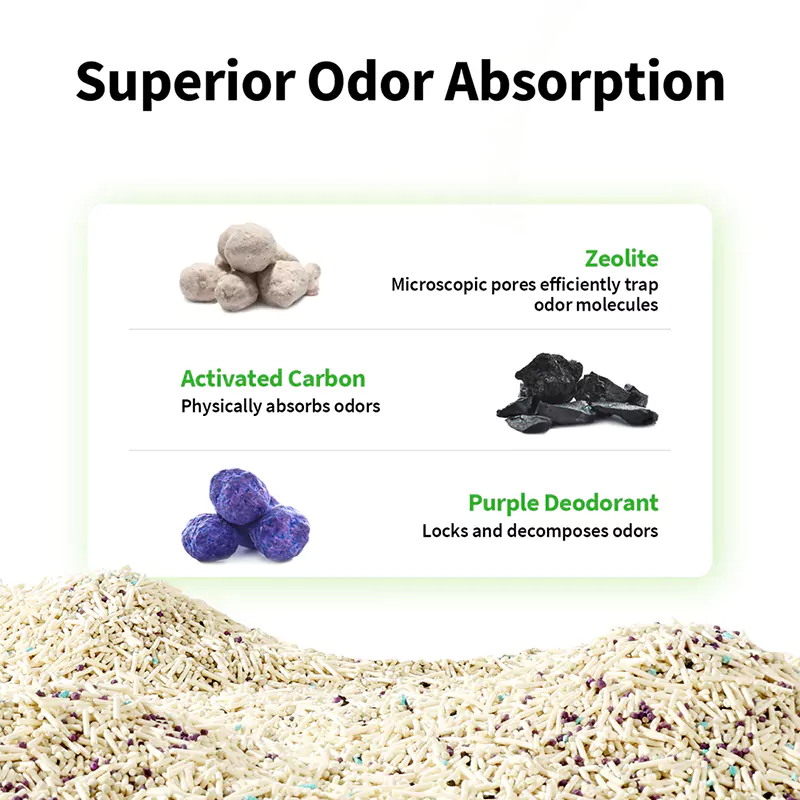
Single-mechanism litters rely on one odor control pathway — either physical absorption (tofu, bentonite) or molecular adsorption (activated carbon, silica). Either alone is insufficient for high-use environments. Our 30-day formula uses both simultaneously.
Most cat litter is tested and certified at standard laboratory conditions (20°C / 50–60% RH). But your customers may be opening bags at 34°C / 88% RH in Singapore, or storing product at -5°C in Finland. The performance gap is real — and avoidable.
If a competitor has a product that consistently out-performs yours, the answer is in the formula. Our analytical chemistry lab can deconstruct any cat litter product to its core components, ratios, and performance characteristics — and build you a version that matches or exceeds it within 14 days.
Every claim we make is supported by data from our own laboratory — not just external certification. Here's what we can measure, simulate, and verify in-house.
Clumping time, clump hardness (penetrometer), water absorption rate, non-adhesion test, and clump integrity under load. Standard and accelerated protocols available.
20+ parameters per batchNH₃ concentration measurement (electrochemical sensor, ppm resolution), VOC panel, odor intensity scoring, and multi-cat use simulation over 7, 14, 21, and 30 days.
5 ppm threshold targetTemperature range −15°C to +45°C, humidity 20%–95% RH. 90-day accelerated aging, shelf-life simulation, and cold-climate clumping validation for any target market.
−15°C to +45°C range30-day vibration test replicating sea freight conditions (0.5–5 Hz, multi-axis). Blend uniformity measured at 5 sample points before and after. Anti-segregation pass/fail certification.
±5% uniformity thresholdXRF elemental analysis, FTIR spectroscopy, SEM imaging, particle size distribution (laser diffraction), and bulk density measurement. Used for formulation development and competitor analysis.
±2% composition accuracyTotal plate count, mold and yeast, coliform bacteria, and pathogen screening. All tests performed to ISO 6887 standard. Results included in COA for every production batch.
ISO 6887 standardWe don't offer vague quality promises. Every R&D engagement includes a Technical Performance Specification that documents the exact parameters we guarantee — and what happens if we don't meet them.
| Performance Parameter | Guaranteed Specification | Verification Method |
|---|---|---|
| Tray Non-Adhesion | < 0.5N release force at 24h Guaranteed | Standardized adhesion test, penetrometer |
| Clumping Time | Full clump formation < 5 seconds Guaranteed | Video timer, 30mL water application |
| Clump Hardness | Customer-specified ±10% tolerance Guaranteed | Penetrometer, 24h cured clump |
| Blend Uniformity (mixed) | ±5% component ratio post-30d shipping test Guaranteed | 5-point sampling, gravimetric analysis |
| Odor Control Duration | NH₃ < 5 ppm at specified day target Guaranteed | Electrochemical NH₃ sensor, use simulation |
| Dust Rate | Customer-specified, typically ≤ 0.1–0.5% Guaranteed | Particle counter, ISO 15767 protocol |
| Climate Performance | Full spec compliance at target market conditions Guaranteed | Climate chamber, 90-day simulation |
| Formula IP Protection | NDA — not supplied to any other client Guaranteed | Signed mutual NDA, legal binding |
| Reverse Engineering Match | ≥ equal performance on all 15 parameters Optional upgrade | Comparative performance report, all parameters |
| Full IP Transfer | Formula ownership transferred to client Optional upgrade | IP transfer agreement, legal documentation |
If we do not meet a guaranteed specification on delivery, we re-run production at no additional cost. This commitment is documented in our R&D engagement agreement.
A structured, transparent process with defined outputs at every stage. You always know where you are and what comes next.
Send us your current formula, the failure mode, and your target market. We'll respond within 24 hours with a proposed approach, timeline, and cost estimate — at no commitment.